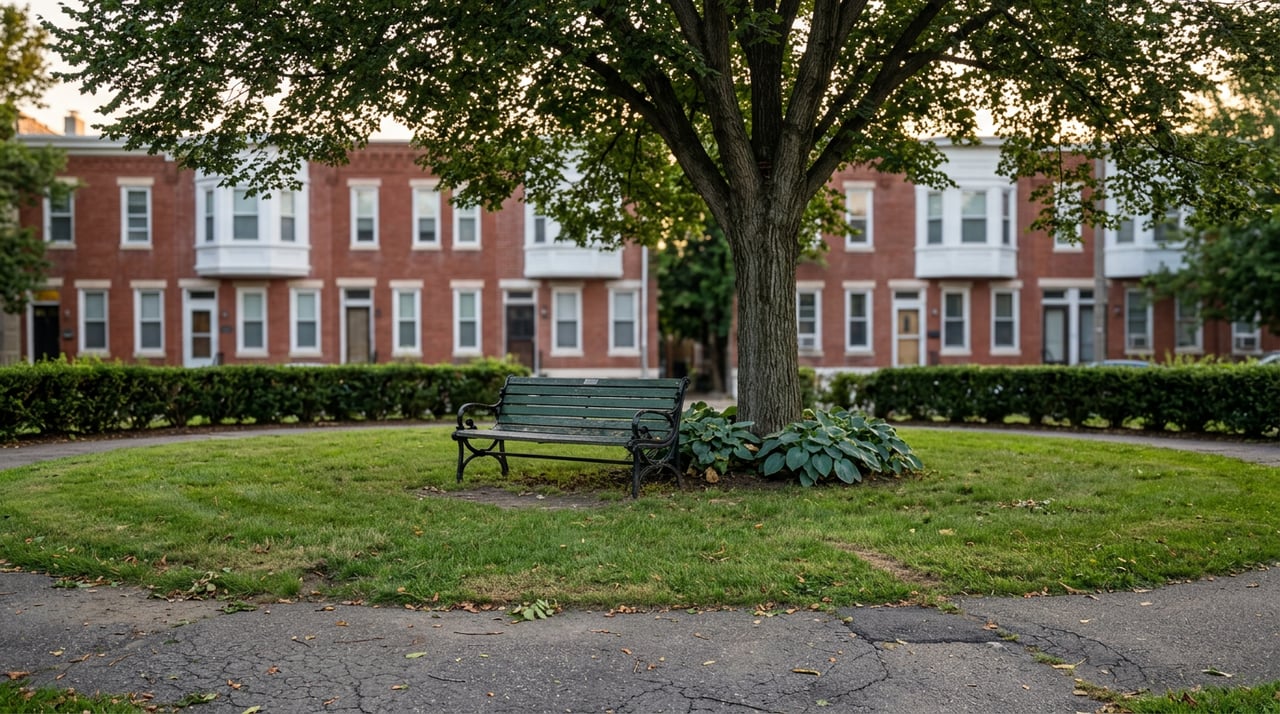
Walk the park at Logan Circle any evening in August and you'll see the same cast of characters that showed up in June: a retriever mix straining toward another dog three benches down, someone reading on a blanket while the sky goes orange behind the rowhouses, two neighbors catching up standing up because sitting down would mean admitting the conversation is over. None of them are thinking about reservations at Le Diplomate or the wait at Pearl Dive. They're just here, on a Tuesday, because the circle is free and it's theirs.
That gap between what gets written about Logan Circle and what residents actually do in it is worth naming. Outside coverage treats the neighborhood as a tasting menu of restaurant openings along 14th Street. But the two things that actually organize a Logan Circle calendar this year, one that just happened and one that repeats every month, have nothing to do with a chef or a menu. They're both about buying things secondhand or homemade, on a sidewalk, from a neighbor.
The Corridor Sold Furniture Before It Sold Small Plates
Before 14th Street became shorthand for a hot restaurant strip, this stretch of Northwest DC was known for something more mechanical. The corridor's older buildings, the kind with wide street-facing bays and high ceilings, were built to display cars, not serve them oysters. Room & Board's current location still shows it: a converted vintage car showroom with a roof deck bolted on top of what used to be a sales floor.
The retail habit never left. Miss Pixie's Furnishings & Whatnot has been rotating through antiques and reclaimed furniture on this strip for years, the kind of shop where the inventory changes weekly and the appeal is exactly that unpredictability. Salt & Sundry sells kitchen goods and locally made crafts a few doors down. West Elm anchors the corridor's national-brand end. None of these businesses are new, and none of them are food. They're the neighborhood's original commercial identity, and they're still doing the job.
Two Fixed Points, Neither One a Menu
If you want proof that Logan Circle's real rhythm is retail, not dining, look at what actually repeats.
Dog Days, the corridor's annual sidewalk sale, just wrapped its 26th run on Saturday, August 1, 2026, organized through Logan Circle Main Street. Twenty-six years puts its start around the turn of the millennium, roughly a decade before Pearl Dive Oyster Palace opened its doors in 2011 and well before Mallard arrived in 2024 under former Vidalia chef Hamilton Johnson. The sidewalk sale is older than most of the restaurants people now associate with this neighborhood. It didn't get invented to complement a food scene. The food scene grew up around it.
The newer institution points the same direction. The Logan Circle Creative Market meets the first Sunday of every month along P Street and Rhode Island Avenue NW, organized by Logan Circle Main Street in partnership with a small cluster of local businesses:
- K-Bird, hosting part of the market along its storefront
- Barrel House Cafe & Bar, anchoring the northern end
- LOVERS Plant Studio & Wares, whose owner Emily curates the vintage and flea market portion
The market ran June 7 and July 5 this year on that same first-Sunday pattern, and by the pattern's own logic it also would have run on August 2, a week before this post went up. If the schedule holds, the next one lands September 6. It's vintage vendors, artists, and small makers, not a pop-up dinner series. A neighborhood association could have organized almost anything to build monthly foot traffic. It chose a flea market.
The Restaurants Are Newer Than the Habit of Shopping Here
None of this is a knock on the food. ChurchKey's beer list still runs past 500 selections. Colada Shop still does a brisk trade in Cuban sandwiches and second-floor patio cocktails. Mallard's arrival two years ago added a serious Southern kitchen to a corridor that already had plenty of French bistro and Southeast Asian options. These places matter to the neighborhood's evenings, and nobody living here is skipping dinner out of loyalty to a furniture store.
But the restaurants are the part of Logan Circle that outsiders discover first, because restaurants are what travel in write-ups and reservation apps. The sidewalk sale and the monthly market don't travel the same way. They don't need to. They're built for people who already have a key to a building within walking distance, which is a different audience than a food writer parachuting in for a tasting menu roundup.
The Park Doesn't Care About Any of This
Underneath both calendars, the daily one and the monthly one, sits the actual constant: the circle itself. It's a public park built around a statue of Civil War general John A. Logan on horseback, ringed by Victorian rowhouses that predate every business on this list. Nobody schedules the park. Nobody curates it. It's just open, every day, and it's where the neighborhood actually spends its unstructured time, dog walking, reading, the kind of loitering that doesn't show up in any events calendar because it isn't an event.
That's the part a restaurant roundup can't capture. The park is what makes Logan Circle feel lived-in rather than visited. The sidewalk sale and the monthly market are what make it feel organized. The restaurants are what make it look interesting from the outside. All three are true at once, but only two of them repeat without anyone having to book a table.
What This Means If You're Already Here
If you moved in expecting a neighborhood built around its restaurant reviews, the actual texture takes a beat to notice. The people who get the most out of Logan Circle aren't the ones treating 14th Street as a tasting menu. They're the ones who know Miss Pixie's inventory turns over often enough to check back monthly, who mark the first Sunday of the month for the Creative Market before they mark a dinner reservation, and who treat the park bench as the default plan on a free evening rather than a fallback.
None of that requires spending money. It requires paying attention to a calendar that doesn't get written up nearly as often as the restaurant openings do, mostly because it doesn't need the coverage to keep working.
If you're weighing a move to Logan Circle, or you already call it home and you're thinking about what comes next for your own place here, Roger Taylor knows this corridor block by block, sidewalk sale included. Let's Connect.